Thursday, 26 February 2009

HORROR - Individual Research

The intention of a horror film is to scare the audience while captivating and entertaining them at the same time. Horror films strive to elicit responses of fear from the audience, and are designed to frighten and panic viewers. Whatever dark, primitive, and revolting traits that simultaneously attract and repel us are featured in the horror genre.
Horror films go back as far as the onset of films themselves, over 100 years ago. From our earliest days, we use our vivid imaginations to see ghosts in shadowy shapes, to be emotionally connected to the unknown and to fear things that are improbable. Watching a horror film gives the audience an escape into another world, and it lets us go on a rollercoaster of emotions with the characters we identify with, from the comfort of our own living room or the cinema. In these particular surroundings, we know that we aren’t in any danger and aren’t going to get hurt, so we can face our fears head on.
Horror films, when done well and with less reliance on horrifying special effects, can be extremely influential film forms, tapping into our dream states and the horror of the irrational and unknown, and the horror within man himself. The best horror films only imply or suggest the horror in subtle ways. Rather than blatantly displaying it, the audience are left to create their own picture of the villain/evil, as in Scream(1996) and Halloween(1978). The anonymity of the killer usually makes for a scarier and plot and essentially a scarier film.
In typical horror films, a three part narrative can usually be observed. This is when there is a state of equilibrium at the start of the film. At this point, the audience will be introduced to the characters that will play big parts in the plot of the film in one way or another. In the next section of the film, there will be some sort of conflict that breaks the equilibrium, thus creating disequilibrium and a sense of unease for the audience. It is mostly likely that at this stage of the film, majority of the story will unfold. At the end of the film, the equilibrium will be restored and the area in which the events took place will return to how it was. However, sometimes in horror films, the audience are only led to believe that equilibrium has been restored, and the source of terror/evil is still around somewhere.
The earliest horror films were gothic in style. They were usually set in old spooky mansions or castles, and would be bathed in moonlight and fog. This is partly because it, at the time, was the only way they could be film because of the lack of the equipment studios have today. However, the main reason that they were filmed in this way is because the films were largely based on classis literature of the gothic/horror genre such as Dracula.
Horror films develop out of a number of sources: folktales with devil characters, witchcraft, fables, myths, ghost stories, and Gothic or Victorian novels. Probably the most well known horror writer is Bram Stoker, who created arguably the most famous horror character of all time – Dracula. This character is the one that is most frequently portrayed in horror film, with about 160 representations of the 500 year old blood sucking vampire.
The earliest horror films were produced in America from 1909 to the early 1920’s, making the genre of horror one of the oldest and most basic. Before the 1930’s, Hollywood was reluctant to experiment with the themes of true horror films. Instead, the studios took popular stage plays and emphasized their features of mystery, whilst still providing rational explanations for all the supernatural elements.

By the early 1930’s, horror entered into its classic phase in Hollywood. The studios took morbid tales of vampires, undead aristocrats, mad scientists and invisible men, and created some of the most archetypal creatures and monsters to ever grace cinema screens. Universal Studios was best known for its pure horror films in the 1930’s and 1940’s, and its horror characters – Dracula, Frankenstein and The Mummy, to name a few. It also produced famous horror actors like Bela Lugosi and Boris Karloff.
Horror films branched out in all different directions in the 1960’s and onwards. Especially as the Production Code disappeared, giving the studios less boundaries, and film censorship was on the decline. Directors began to frankly portray horror in ordinary circumstances and seemingly innocent settings that the audience could identify with. Around this time, directors like Roger Corman were producing low budget and quickly-made films, and the British film studio Hammer Horror was making sequels to Dracula and Frankenstein. Also around this time, directors varied the type of horror that was used in films e.g. psychopathic murderers, and more suspenseful, atmospheric horror. However, this doesn’t mean that gothic horror had been forgotten, it was simply being modernized and brought up to date. This is evident in Whatever Happened To Baby Jane? (1962).
Although Alfred Hitchcock was a well known suspense/thriller director, his early films like The Lodger (1926) did explore themes of horror. Although I have previously discussed Psycho (1960) as a thriller film, it still very easily falls into the horror genre. Psycho changed the face of horror films ever since its release. The pure archetypal horror was discovered in the dark shadows of a human soul, in the form of the psychopathic hotel owner, Norman Bates. The film itself has come to influence a number of Hollywood horror films, especially the ‘slasher’ horror subgenre. Hitchcock didn’t only use the evil within a person to scare an audience. In The Birds (1963), a coastal town and its inhabitants are attacked by a flock of birds.
The horror director George Romero is famous for incorporating the theme of zombies into his films. Romero’s most notable horror films is the Dead series (5 films in total).
-Night of the Living Dead (1968) – A documentary style film, shot in grainy black and white, that welcomed an entire subgenre of horror to cinema.
-Dawn of the Dead (1978) – The gory sequel to Night of the Living Dead followed the survivors of a zombie attack seeking refuge in a shopping centre. There is a classic quote in the film made by Ken Foree, which explained the occurrence of the zombies, “When there’s no more room in hell, the dead will walk the Earth”. A remake of the film was released in 2004.
-Day of the Dead (1985) – A group of scientists performed experiments on the zombies in hopes of finding a cure for the plague. This was until the zombies turned on them.
-Land of the Dead (2005) – A symbolic story between upper and lower class survival.
-Diary of the Dead (2008) – A film within a film. It was considered as an updated 21st century presentation of the zombie story for the YouTube and MySpace generation.
In the 1970’s, filmmakers created horror films noteworthy for their shocking expositions of body mutilation, bold use of colour and electronic music, everyday and isolated locations and the sexual exploitation of female victims, made all the more vivid by the turn to realism in films of that era in general. The critical and popular success of Rosemary's Baby
(1968), directed by Roman Polanski and starring Mia Farrow prompted the 1970’s occult explosion, which included the box office smash The Exorcist (1973) directed by William Friedkin. The Exorcist deals with the demonic possession of a young girl, played by Linda Blair, and her mother’s desperate attempts to win back her daughter. It became one of the most profitable horror films of all time (winning two Academy Awards), and until The Silence of the Lambs in 1991, it was the only horror film to be nominated for Best Picture in the history of the Academy Awards. To date, The Exorcist has been named as one of the scariest films of all time. Another popular film about a demonic child is The Omen (1976), where a man realizes that his five year old adopted son is the Antichrist. The occult explosion included numerous horror films in which the Devil became the supernatural evil, often by impregnating women or possessing children. Also in the 1970’s, the famous horror author Stephen King arrived on the film scene. Many of his books were adapted for the screen, beginning with the adaptation of his first published novel, Carrie (1976). As well as its ability to scare people, Carrie is probably better known for its psychological exploration. In 1978 John Carpenter created Halloween, this was around the same time that Sean Cunningham starting to produce Friday the 13th (1980). Both of these films kick started the modern ‘slasher film’. They also inspired numerous, mostly inferior sequels. This subgenre was imitated by dozens of increasingly violent films made throughout the subsequent decades. Jamie Lee Curtis made her film debut in Halloween, playing the role of Laurie Strode – the only central teenage character in the film who is not killed. Laurie Strode’s survival in Halloween is what initiated the convention of a person’s chance of survival being directly linked to their morals. The film was a major success and was considered the highest grossing independent film of its time, earning the status of a classic horror film. Jamie Lee Curtis (who, coincidently, is the daughter of Janet Leigh, who played Marion Crane in Alfred Hitchcock’s Psycho) was subsequently cast in several horror films, and she soon became known as the ‘Scream Queen’ because of her roles.
In 1975, Steven Spielberg began his Hollywood career with the film Jaws, a blockbuster notable for not only its expertly crafted horror elements but also for its success at the box office. Jaws is often credited as one of the first films to use elements such as horror and gore in a big-budget Hollywood film. Alien (1979) combined the naturalistic acting and graphic violence of the 1970’s with the monster film plots of earlier decades, and reacquainted horror with science fiction. It spawned a long-lasting franchise and countless imitators.
The 1980’s were marked by the growing popularity of horror movie sequels. The seemingly endless sequels to Halloween (1978), Friday the 13th (1980) and Wes Craven’s successful supernatural slasher A Nightmare on Elm Street (1984) were the popular face of horror films in the 1980’s. Most of these sequels or imitations were exploitative and featured shocks and gory violence. Another common convention was the theme of teenagers – usually female – being stalked by a homicidal male psychopath. Another trend that appeared in the 80’s was the infusion of blatant comedic elements into films. As the cinema box office turned to more serious films, the genre of horror began to fade away. However, the genre found a new audience in the growing market of home video. The names of the killers in horror films of the 80’s have become landmarks of the genre e.g. Freddy Krueger (A Nightmare on Elm Street), Jason Voorhees (Friday the 13th), Jack Torrance (The Shining).
In the first half of the 1990’s, horror continued many of the themes from the 1980’s. Sequels of famous 80’s horror films continued to make money. Films like Candyman (1992) were part of a mini-movement of self-reflective horror films. They touched upon the relationship between fictional horror and real-world horror. In Candyman, the film examined the link between an invented urban legend and the realistic horror of the racism that produced its villain. Two main problems pushed horror backwards during this period. Firstly, the horror genre wore itself out with the overuse of nonstop slasher and gore films in the 80’s. Also, the audience that feasted on the blood and gore of the previous decade grew up, and the replacement audience for films of an imaginative nature were instead being captured by the explosion of sci-fi and fantasy, courtesy of the big budgets and computer generated special effects, which horrors lacked. To re-connect with its audience, horror became more self-mockingly ironic, especially in the latter half of the 90’s. Wes Craven’s Scream trilogy, beginning in 1996, featured teenagers who were fully aware of, and often made reference to, the history of horror films, and mixed ironic humour with shock. Along with I Know What You Did Last Summer (1997) and Urban Legend (1998), they re-ignited the dormant slasher film genre. Among the popular English-language horror films of the late 90’s, only 1999’s independent hit The Blair Witch Project attempted straight-ahead scares in the context of a mock-documentary.
The start of the 2000’s saw a quiet period for the horror genre. Film making studios realised that profits could be made by cheaply re-making classic horror films, many were watered down, familiar films without any further originality. These include:
-House of Wax (1953/2005)
-Black Christmas (1974/2006)
-The Amityville Horror (1979/2005)
-The Fog (1980/2005)
-Prom Night (1980/2006)
Final Destination (2000) marked a successful revival of clever horror that was centred on teenagers. The clever thing about the film was that there wasn’t actually a person physically chasing them, instead they were stalked by Death itself. Final Destination was successful because although it was a fictional film, there is a serious issue that is dealt with. The teenagers ‘cheat Death’ after someone has a premonition about a plane exploding. Death then comes back to complete its original design of what should have happened on the plane, and the survivors eventually die in freak incidents, in the order they would have done on the plane.


In 2003, two of 1980’s most recognisable horror characters went head to head in Freddy vs. Jason. Some notable trends have marked horror films in the 2000s. The Others (2001) was a successful horror film of that year and was the first horror in the decade to rely on psychology to scare audiences, rather than gore. There has been a minor return to the zombie genre in horror movies made after 2000. The Resident Evil video game franchise was adapted into a film released in 2002. Two sequels have followed. The British film 28 Days Later (2002), directed by Academy Award winner, Danny Boyle, featured an update on the genre with a new style of aggressive zombie. The film later spawned a sequel, 28 Weeks Later (2007). A new subgenre of horror that has started to emerge in recent films is ‘torture-porn’ or ‘gore-nography’. Some examples of films in this genre are Saw (2004), Hostel (2005), Captivity (2007) and their respective sequels. Another variation on the horror genre was the blending of ‘chick-flicks’ with a traditional horror/adventure film. The Descent (2005) was one of the first all-female action horror films. For the characters, six unknown actresses were used. This is so that the audience didn’t identify with them as much as they would have if they had been well known actresses. In 2007, Rob Zombie wrote and directed a remake of John Carpenter’s Halloween. The film focused more on Michael Myers’ childhood than the original 1978 film did. The slasher genre is standing strong in cinema today...
-A remake of the 1981 horror My Bloody Valentine was released in the cinema on 16th January of this year.
-A remake of Friday the 13th was released in the cinema on Friday 13th of February of this year.
-The sixth installment of the Saw series is set to be released later in the year.
-The fourth film in the Final Destination series – Final Destination: Death Trip 3D is set to be released in August.
-and finally, Scream 4 is currently in production for a 2010/2011 theatrical release.

Saturday, 24 January 2009

HORROR - Analysis

Halloween:
Halloween is a 1978 independent horror film directed by John Carpenter. The film stars Donald Pleasence, Jamie Lee Curtis and Nick Castle.
The film became notoriously popular and has gone down in history as one of the most terrifying horror films of all time. Rather than relying on computer generated special effects (which could be argued are overused in recent films), the creators of Halloween came up with a realistic way of scaring audiences - by playing upon every man, woman and childs basic fear of an unstoppable force of evil. The film has inspired many of todays horror cliches and the basic formula is widely popular and recogniseable in the modern horror genre. Halloween established a significant convention that is still evident in horror films over 30 years after its release- Myers victims are all sexually promiscuous, while the lone heroine (Jamie Lee Curtis) is depicted as innocent thus making the audience want her to defeat him. Since Halloween was released, the direct link between a character's moral strengths and their likelihood of surviving the films conclusion has become a standard convention of slasher horror films.
The credits of the film fade from orange to red, a connotation of good versus evil. Similarly, it could show the conflict between life and death. The background of the credits is black, an indication of an evil presence in the film. The other prominent feature in the opening credits is the pumpkin. The candle that is inside the pumpkin is violently flickering but fails to go out. This suggests that the killer in the film is unstoppable. There is a slow zoom into the pumpkin, suggesting that the film will build up. When the audience get to see the pumpkin close up, it is noticeable that the shapes are cut out roughly, almost as if done by a child. The camera gets so close to the pumpkin that part of it's 'face' is hidden, this could be a hint for a theme of the rest of the film.
The opening of Halloween is famous for being filmed in a single take (with one seamless cut towards the end). It also uses a subjective point of view to produce vulnerable, unsteady feelings withiun the audience. The setting of the film is the small, quiet town of Haddonfield, Illinois in 1963. It is Halloween night and the children in the neighbourhood are celebrating. The establishing shot of the sequence provides the audience with the knowledge that the area is quiet and somewhat cut off from help. The house that is shown is white, indicating innocence. There is an unidentified figure watching from the outside as a couple of teenagers are in the living room together. The audience are instantly trying to work out who the person behind the camera is. The girl mentions that her brother "Michael is around some place". The girl and her boyfriend go upstairs and the person who is watching tham notices that the light has been turned off- signifying that they are having sex. After we see the boyfriend leave, the subjective camera follows the mysterious figure to the back entrance of the house and into the kitchen. He takes a large knife from the drawer. At this point, through the use of mise-en-scene, the audience start to become aware of the fact that this character will be the evil aspect/character in the film. The character then proceeds through the house as if he knows his way around. The figure picks up a clown mask and clearly puts it on, restricting the audiences point of view to that of the charcters- through the eye holes of the clown mask. The character than creeps upstairs, he enters the room where the girl is brushing her hair. When she recognises that someone is there, she says "Michael", it is at this point that we know that they are brother and sister as she had mentioned him earlier. Although she tries to defend herself, he furiously stabs her to death and she tumbles to the floor. As with another classic horror scene - Norman Bates stabbing Marion Crane in the shower (Psycho-1960) - there is only the implication that the knife penetrates the skin of the victim. Michael then leaves the rooms and goes outside of the house. Whilst standing on the front lawn, Michael is unmasked by his shocked parents. As he stands motionless on the grass, the audience do not see any emotion or remorse in his face. A crane shot slowly rises from him and widens the view, placing him within a quiet, suburban neighbourhood. The first thing that the audience notice is that Michael is a young boy, but they had been expecting an older character. It also poses the question - what will he be capable of when he is older?? Also, the boy is wearing a clown costume. On one hand there is the clown mask, and on the other hand there is a large kitchen knife - this shows the conflict between good and evil, and also the irony of the situation as clowns are meant to be happy and make people laugh instead of the image that Michael is portraying. Regarding the characters in the scene, the audience are not familiarized with one character in depth, however we are shown the situation/world through Michael's eyes, this suggests that we wont find much else out about him, which constantly adds to the audience's curiosity of him and his reasons for doing what he does. A lot of the time, Michael Myers is credited as 'The Shape'.
The opening of Halloween is set at night time which gives the impression that people who could be potential help for the victims are asleep or not available. The house is in darkness, which hides Michael in the shadows. It also adds to the suspense of the scene as the audience are curious as to what is going on. Also, the sisters room is lit up and she wouldn't be able to see Michael in the dark hallway, and the audience automatically empathise with her.
The sound and music in the sequence also contribute to building the tension within the audience. The sound/music is very sharp and harsh and this type of soundtrack ie- violins/strings has become very popular in modern horror films. It could be argued that without the soundtrack/scor, the film would be nowhere near as scary/frightening. The music carries on from the credits to the first bit of the film thorugh the use of a sound bridge. It continues the theme that was discussed in the credits (sinister background). This sound is non-diegetic as it is not in the scene, and the characters cannot hear it, it gives the audience the advantage of being warned when something is happening. There is ambient sound at the beginning of the sequence as we hear the sound of crickets outside - this indicates how still the surrounding area is, and on the surface it appears that nothing strange is happening.

Scream:
Scream is a 1996 film directed by Wes Craven. The film revitalised and re-defined the slasher genre in the 90's, similar to the impact that Halloween had on the late 70's films, by using a standard concept with a tounge-in-cheek approach that combined straightforward scares with dialogue that followed slasher film conventions with a twist. The film featured many teen idols of the time including: Neve Campbell, Drew Barrymore, Matthew Lillard and Courteney Cox Arquette.
When the title of the film appears, there is a loud bang. The writing is white which connotes innocence. The title then flashes to red and the audience can hear screams in the background. It is as if someone is dying as the elements on the screen alter. Just before the sequence begins, we can hear a phone ringing, this suggests that the phone may play a prominent role in the sequence. Through the use of a sound bridge, the ringing continues when the film starts. The camera follows the phone as it picked up by a young blonde haired girl. The voice on the other end of the phone is that of an older male. It also seems that the girl doesn't know who the caller is. The audience cannot make any judgement on the character yet, as we do not know who he is or what he looks like. When Drew Barrymore starts to walk away, the audience can see in the background and it is visible that her family is wealthy as they live in a large spacious house.
The phone rings for a second time, she turns around and a reaction shot shows that she is as curious about the caller as the audience is. When she picks up the phone, there is a canted frame, which makes the audience feel uneasy and off-balance. We can tell that she is confused, and the camera gets closer to her face to shows this. As she is about to hang up, the caller says "wait, wait", and the camera moves quickly to reflect that the caller is anxious to keep her talking on the phone.
The camera then cuts to an exterior shot, to show the audience that although the house is lit up inside, it is very dark outside, giving someone the opportunity to hide. There is then a tilt down to a shot of the house. This shot could be considered as an establishing shot. It also gives the impression that there is someone spying on the girl from outside, making it a point of view shot. The only sound in this shot is the noise of the crickets outside, this makes the area more still and isolated. The large house is typical of what you would expect in suburbia. The swing that is hanging from the tree is swaying to and fro, this is a possible indication of someone's presence.
There is then a cut to an insert of the hob being lit inside the house. The phone rings for a third time and the girls sigh indicates that she is getting slightly annoyed by the caller. He refuses to tell her his name which adds to the increasing tension throughout the scene. She tells him that she is making popcorn and going to watch a scary film, which is ironic as it is what the audience are doing. It makes us feel empathetic towards her. When she refers to Halloween as one of her favourite films, she picks up a large kitchen knife, this is an intertextual reference to the iconic 1978 horror film. The popcorn acts as a timer in the opening, as the events unravel, the popcorn gets louder and louder. It shows the suspense building up. Drew Barrymore starts to walk around the kitchen, and the camera follows her. This gives the impression that someone is stalking her. She starts to walk into the living room, and an over the shoulder shot suggests that metaphorically, there is some standing over her shoulder as she walks around. There are a lot of shadows in the room, and it is hard to distinguish where the shadows are coming from.
Later on, the caller mentions that he wants to know who he is looking at, Drew Barrymore's reaction mirrors that of the audience. We start to wonder where the caller is and whether he really can see her or not. A dog barks outside, which is commonly a sign that something out of the ordinary is happening. She looks around whilst still talking, and starts to think that something bad is happening. She turns on the patio light to try and see something outside, there is a point of view shot so the audience are put in the position of the girl. Also, we see that the family have a pool, which is a sign of their wealth.
When she hangs up, there is an insert of the popcorn, which has started to smoke, this is an indication of the uncontrollable situation she has found herself in. As the scene progresses, the lighting gets subsequently darker to reflect the tone. Also, when she is in the phone to him, she is cut off from sources of help as she is talking to him. It is noticeable that as the sequence unfolds, the camera angle gets wider, and the movement becomes more unstable. This allows the audience to see more of what is going on in the background. The next time the phone rings, the girl appears to be scared, and we start to develop negative associations of the phone ringing. When the caller threatens her, there is a zoom into her reaction. The sinister voice on the phone lets the girl know that he can see her as he referes to her as 'blondie'. The music builds builds up and gathers pace as she frantically runs around locking all the doors. The camera following her is unsteady to reflect the scene. He reinforces to her that no one can help her as they are in the middle of nowhere.
Drew Barrymore is shown as weak and helpless, she is sobbing uncontrollably and seems unsure of herself. She is on edge and jumps when the doorbell rings. She walks backwards into the living room, this is symbolic of her being forced to go somewhere that she doesn't want to go, or into the unknown. There is apoint of view shot as she backs away from the door, this shows her getting further and further away from her escape/exit. Whilst the girl is very frantic on the phone, the caller is calm and relaxed.
The caller lets her know that she knows her boyfriend's name, through the reacton shot of the girl, we realise at the same time that she does that the caller must be someone she knows. Later in the scene, we see her boyfriend, Steve, tied up outside on the patio and he is wearing a football jacket, this is a typical convention of horror films- the victims being teenagers. When the girl asks the caller "Where are you?", Steve looks to either side of him, this is a hint that maybe there are two people involved and they are tricking her. Her boyfriend holds his hand up and much as he can as if to tell her to stop. Steve knows something but he cant tell her.
When Casey is hiding behind the television, the caller asks her some horror film trivia. There is non-diegetic sound being played very faintly in the background, this is the music from Halloween, a film which had a big influence on Scream. As she answered a question wrong, Steve gets killed. This, however, happens off screen, and the audience only hear the sounds of the knife and Steve screaming. When she refuses to answer the next question, the killer throws a chair through the window right next to her.
She runs through the kitchen, which by now is filled with smoke and beginning to start a fire, and grabs the large kitchen knife she picked up earlier. The pace of the scene changes and is a lot more rushed as we now know for definite that the killer is intending to get her, whereas before it could have been a prank.
We briefly see someone, obviously the killer, run past the corridor, and the burst of music intends to shock the audience. Even though we saw Casey lock all of the doors, the killer has managed to get into the house. He glides through the house and appears to be experienced at what he is doing.
In one hand, Casey has the phone to symbolise that although he is not right next to her, the killer is always close. In the other hand, she has the knife to show her will to survive. We wouldn't normally expect a young blonde teenage girl (in horror films) to be able to stand up for herself as Casey does. The two props show that whilst she is in a vulnerable situation, she is still determined to escape. They also balanc each other out. Casey creeps outside and hides under the window in hopes of escaping the ordeal. The audience believe that she has 'out-smarted' the killer at this point as the killer is still inside.
There is a cut to an extreme long shot of car lights in the distance driving up to the house. The shot is also from the point of view of Casey to make the audience feel her desperation. She starts to crawl away,believing she is safe. However, when she looks back into the house, there is a crash of music as the killer turns around and faces her. For the first time, the audience see the killer close up. Casey's reaction, once again is reflective of what the audience would do - scream!! The killer smashes through the glass, and although she seemed helpless at first, Casey uses the phone that had terrorized her earlier to hit him in the face.
At this point, the car is getting closer to the house, which makes us think she will almost cartainly escape. Once again, the killer smashes through the glass. There is a long shot of the girl running away from the killer. This is done in slow motion to show how her chance of survival is slowly slipping away. It is also a way of showing what both of the characters are wearing. Drew Barrymore is dressed in light colours with blonde hair - a sign of her innocence. Also, at this stage, we have not seen the killers face and the audience are left to imagine who or what is under the mask. The killer is wearing a black cloak with a white mask. One connotation of his costume could be a reminder of the Grim Reaper. It could show that although he is almost completely dark, there is still a different side to the character. It also introduces the potential theme of good versus evil.
When the killer stabs Casey, there is no music and only diegetic sound, this automatically puts the audience into the scene. As she collapses onto the floor, we see her white top stained with blood, and the audience are starting to believe that she has no chance of survival. Her heavy breathing and sobbing shows that she is slowly losing her life. When he goes to stab her for a second time, she manages to knock the knife out of the killer's hand, which is an indication of her strength. At the top of the frame, we see that she is still holding onto the phone. She kicks him away from her and, considering how she has just been stabbed, the audience wonder how powerful the killer actually is. There is then a shot from Casey's point of view lying on the floor, trying desperately to get her parents attention. As she manages to get to her feet, there is an over the shoulder shot as he walks behind her with the intention of killing her.
When Casey finally realises that she has no chance of living, she reaches up to reveal the killers identity. The audience, however, are not shown/told who it is. The shocked expression on Casey's face is an indication that she knows who it is. There is a freeze frame of the knife that the killer has raised above his head. It is against a dark background, which draws our focus to the knife.
Inside the house, the fire alarm starts to go off, this is a symbol of Casey dying at the same time. Also, the popcorn is put into the sink by her Mom. This signifies the end of Casey's night- and her life.
There are cuts between shots of the parents and shots of the killer stabbing Casey. When her Mom tries to ring the police, Casey is still on the phone so even they cant help her. When the killer puts down the phone, it is a sign that Casey is dead and cant get any help. There is a medium close up (which is also a two shot) of the parents, so the audience can see their emotions. We also feel sorry for the parents because we know more than they do about what has happened. The man tells the woman to "drive up to the Mackenzies", the fact that they have to drive to their nearest neighbours shows how they are isolated they are.
When the Mom gets outside she screams, the audience are curious as to what she has seen. She falls to the floor and out of the shot, and the Dad goes to look. The slight zoom in to his reaction indicates that he has seen something terrible. There is an extreme long shot of Casey hanging dead from the tree. The camera quickly zooms into Casey. It is so quick that the audience hardly have a chance to process what is happening. There is a flash and the screen goes black, showing the end of the sequence.
The sound in the opening of the film is typical of a horror film. It builds up and down through the scene and is parallel to the action in the sequence. The string instruments manipulate the audience into believing that something is going to happen.
There are a lot of red herrings, even in the opening 10 minutes of the film. The audience are built up to expect something and when nothing happens, they relax again - this is when they get the shocks. The knife that the killer uses is a common of weapon in horror films and often symbolises a gory death.
The opening of Scream kills off arguably the biggest star of the film - Drew Barrymore - so early. This creates an alientation effect by killing the apparent centre of the film and makes us thinks that anything could (and probably will) happen. Scream is famous for its intertextuality, a lot of which is evident in the opening scene. The victims later on in the film are quite self aware. They each make clear their knowledge of, and poke fun at, teen slasher films. The references in the opening include:
- When A Stranger Calls: Victim being taunted over the phone
- Nightmare On Elm Street: Conversation about the film
- Friday the 13th: Conversation about the film
- Halloween: Casey picking up the knife (Michael Myers)
: Costume (Michael Myers' face being hidden by a white mask)
: "Drive down to the Mackenzies" (Quote from Halloween)
: Casey stumbling forward, unable to speak, towards her parents (Halloween II - Laurie running towards Dr. Loomis), the killer close behind ready to attack
The shots of a bloody knife in the air before stabbing Casey is a horror film cliché. In almost all Halloween and Friday the 13th movies, before the killers knife comes down killing the helpless victim, they always show it pausing in the air.

Saturday, 10 January 2009

HORROR - Codes & Conventions

Codes and Conventions

-Set in suburbia: There is usually the idea of equilbrium being broken one way or another. When the film is in suburbia, it is likely that there will be a friendly community, where everyone thinks that they know each others business. It will also be a lot quieter area, and may give the impression of isolation and being cut off from the city or sources of help.

-Hero/Villain: There will be a seemingly vulnerable character who will be stalked by a tyrannical character. The basic plot of most horror films follows the villains failing attempts at catching/killing the innocent victim. Majority of the time the victim will prevail as a hero/heroine who overcomes the force of the evil character.

-Female teen victims: In a lot of classic horror films, the victims will be naive, vulnerable teenagers, and most likely female. In some way or another, their innocence is compromised or taken away. However, in more recent horror films, it is beoming increasing popular to have a group of teenagers of both gender put in jeopardy. The typical audience of horror films are teenagers, so the characters situations will feel more realistic to them.

-Characters fate changing: At the start of the film, the victim will seem naive and vulnerable. However, as the story progresses, the character will develop and addapt to the situation. Also, at the start, the character will be with his/her friends and they will be safe, however as they separate from the group, their luck will alter and they will find themselves in danger.

-Weapons: Horrors are less likey to be psychological and more likely to be about a physical confrontatiion between the hero and villain. The most common weapons in horrors are knives and guns, sometimes it will be the hero who kills the villain with their own weapon.

-Blood/Gore: Due to the nature of the weapons involved, there will be inevitable blood and gore in a horror film. The confrontations between the hero and the villain will almost always lead to the death of one of them, or both.

-Music: The music used in horrors adds tension to a scene. It will also be used to shock the audience. It is likely that string instruments will be used to create an atmosphere. Music in thrillers builds up, whereas the music in horrors is more about creating the 'shock' factor.

-Darkness: As with thriller films, darkness is used as a device to create suspicion and tension within the audience. Most of the killings/murders, or action in the film for that matter, will take place at night. It not only darkens the settings, but the tone of the film. It restricts what the audience and characters are able to see.

Thursday, 8 January 2009

THRILLER - Individual Research

One question that always arises is "what is a thriller film?". There are many different definitions, but with each one being so different, we are given the impression that maybe there is no concrete definition for a thriller, but just a conclusion of ones interpretation of the genre. However, if the genre is defined strictly, a genuine thriller is a film that relentlessly strives to provide thrills and keep the audience on the edge of their seats as the plot build towards a climax.

Thriller is a broad genre of literature, film, TV and gaming that includes various subgenres which will often overlap. Thrillers are known to be fast paced with lots of action. There is almost always a hero/heroine who must use their own resources to overcome the better-equipped villain. There will be extensive use of suspense, red herrings and cliff hangers.
Thrillers often take place in settings that the audience will recognise eg- New York. The hero in a thriller will usually be male and accustomed to danger eg- police officer, spies or soldiers. However, it is not uncommon for ordinary citizens to get drawn into danger eg- Edward Norton in Fight Club (1999). It is, however, becoming more popular to portray a strong female heroine in thriller films, an early example of this is Sigourney Weaver as Ripley in Alien (1979).

In a thriller, a hero must thwart the plans of a villain, rather than solve a crime that has already been committed. The crimes that must be prevented will be on a grand scale eg- serial or mass murder, terrorism, assassination etc. There will almost always be a showdown between good and evil at some point in the film. The hero is not only trying to save his own life. but that of others who have also found themselves in the situation.

Thrillers may be defined by the primary mood that they elicit: fearful excitement. The audience need to be thrilled for it to be a successful thriller.

There are various subgenres that can be woven into a thriller . . .
ACTION THRILLER - race against the clock, lots of violence, obvious antagonist, guns, explosions, special effects, eg- James Bond, Bourne
CONSPIRACY THRILLER - hero confronts a large powerful group of enemies whose true extent only he realises, eg- JFK (1991)
CRIME THRILLER - suspenseful account of a crime/s, murder, robbery, shootouts, double crosses, eg- Seven (1995), Reservoir Dogs (1992)
DISASTER THRILLER - artifical or natural disaster, floods, earthquakes, hurricanes, eg- The Day After Tomorrow (2004)
DRAMA THRILLER - slower paced, character development, plot twists, eg- The Interpreter (2005)
ECO THRILLER - environmental/biological disaster
EROTIC THRILLER - eg- Basic Instinct (1992), Fatal Attraction (1987)
LEGAL THRILLER - courtroom, fighting for justice and life eg- The Exorcism of Emily Rose (2005)
MEDICAL THRILLER - hero/heroine is a doctor or nurse, hospital, eg- Awake (2007)
PSYCHOLOGICAL THRILLER - mental/emotional conflict rather than physical, eg- Strangers on a Train (1951)
SPY THRILLER - hero= government agent, terrorists, eg James Bond
SUPERNATURAL THRILLER - one of the main characters has supernatural powers, eg- Carrie (1976)
TECHNO-THRILLER - military technologies, technology is essential to the understanding of the plot
HORROR THRILLER - conflict between good and evil are mental/emotional/physical, eg- 28 Days Later (2002), Saw (2004)

Most thrillers will be a combination of various subgenres. The ones that are most commonly used to heighten the tension are horror, conspiracy and psychological. The tension usually arises when the main character is placed in a predicament that is out of the ordinary. Escaping from the situation will seem almost impossible. Life itself is threatened, usually because the main character is unknowingly or reluctantly involved in the events.

One of the most famous thriller directors is Alfred Hitchcock - The Master of Suspense.
He helped to shape the modern day thriller genre, beginning with his early silent film The Lodger (1926). He made cameos in almost all of his films within the first 10 minutes - a trademark of the famous director. Although he was nominated for the Academy Award for Best Director 5 times, he never won it.
Hitchcock is considered as the master of the thriller or suspense genre, and manipulating his audiences fears and desires by showing the viewer the reality facing the character. He would often incorporate a taboo or sexually-related theme into his films like voyeurism in Rear Window (1954), obsession in Vertigo (1958), and the twisted oedipus complex in Psycho (1960).
His films would often put an innocent character in a life-threatenting situation in a case of mistaken identity eg- The Wrong Man (1956).
Hitchcock utilized various cinematic techniques in his films
- Extreme zoom - the key in Notorious (1946)
- Cross cutting 'tennis match' - Strangers on a Train (1951)
- Dolly zoom/Hitchcock shot/Vertigo effect/Contra zoom/zoom in zoom out - Vertigo (1958)
- Montage accentuated with a screeching violin score - Psycho (1960)
The shower scene in Psycho is one of cinemas most stunning and visually effective sequences. A lot of the poignancy is because of the editing. The fast cuts make the scene frantic and realistic.Most of the shots are from the point of view of the knife. This makes the scene much more personal to the audience. Also, it limits the gore in the scene (which is also why it was shot in black and white). In addition, the knife never actually penetrates the skin, and because the scene goes so fast, you think you see more than you actually do - it left a lot to the imagination. I think the scene implies that thrillers are not defined by their subject matter, but by their approach to it. The violin score by Bernard Hermann only adds to the effect and power of the sequence. This would be something to consider if we did a thriller. Psycho proves that it can see really effective without all the gore. Seamless editing is essential, as well as an appropriate sound track.


In majority of his films, there was the inevitable life and death chase concluding with a showdown at a familiar landmark eg- Golden Gate Bridge (Vertigo). He also reveled in confined space to heighten emotion.

The famed director often captialized on a red herring or a plot element to cath the viewers attention. The audience believe that it will be an important feature in the film, but it will intentionally mis-direct the audience, it then quickly fades into the background and ends up being trivial and irrelevant to the films story.
- Rear Window: Suspected murder committed by the apartment tenant
- Psycho: The stolen $40,000 wrapped in newspaper at Bates Motel
- The Birds: The cause of the strange bird attacks.

Hitchcock would typically cast leading actors against type (James Stewart, Cary Grant) opposite blonde actresses (Ingrid Bergman, Grace Kelly, Janet Leigh, Tippi Hendren) who were often subject to abuse, threatening humiliation or murder. Hitchcock would explore the darker sides of human nature through the situation, including sexuality and voyeurism, guilt and punishment, or paranoia and obsession. He would usually let the audience know that something horrible would happen- thus creating suspense while the audience waiting for the inevitable.

Friday, 2 January 2009

THRILLER - Analysis

Red Dragon:
To get more familiar with the thriller genre, we watched some films in lesson. The first film we watched was Red Dragon. It is the 2002 prequel to The Silence of the Lambs directed by Brett Ratner, and starred Anthony Hopkins and Edward Norton.
The film begins in a theatre as an orchestra are playing, it is an extreme long shot as well as an establishing shot, and the setting suggests that the characters in the film are intelligent, upper class people. The camera then slowly zooms into a close up of Hannibal Lector's face, introducing him to the audience. The audience are given the impression that Lector is well educated as he sits and appreciates the music that is being played. The music compliments the slow camera movements. Within the orchestra, there is a flute player who is out of tune. We then see Lector's face once again as he singles out and concentrates on the flut player who is making the mistake. This once again shows his intelligence. The music builds up to a cresendo as the action begins, helping to create tension in the audience and to suggest that something dramatic is going to happen.
The film continues in Hannibal Lector's house at dinner. Hannibal seems very poilte, and when the group are talking about the missing flute player, he remains calm and composed under the pressure. When he is asked to confess, there is a close-up on his worried face- hinting that he knows something. When the person who asked him the question continues with the conversation, Lector seems relieved, showing the audience that he has been up to something, and may have had something to do with the missing flute player.
Lector's house is large, and the furniture inside is very traditional and clearly shows that he is a wealthy man. The ornaments ar-ound the house also show that he is very cultural. Also, it is noticeable that there are a lot of books in the house, continuing the theme of Lector's intelligence. He keeps a tidy house that is full of eccentric artifacts and expensive furniture. This not only gives the impression that he is rich, but also powerful. Also, the carpet in Lector's house is a very dark red symbolizing danger, anger and blood - an ominous sign of what is going to happen.
The lighting in the scene is very dark and reflects the mood and the character that has been introduced. In comparison to the other people in the scene, Hannibal Lector is shown in a darker light, suggesting that he has a darker, more sinister side to him, that hasn't yet been revealed to the audience.
The is extensive use of pans in the sequence to show spacial awareness in the scene. The cuts and editing are slow and steady to gradually entice the audience into the story. Also, it could reflect the way Hannibal Lector works - subtly and silently, progressing unnoticed.
When Will Graham is looking around Lector's possessions, the music builds up as he is discovering new things about the character.The music being played is quite edgey and scratchy, there is also a lot of string instruments being played. The music accompanies the clips in parallel shots. There is a reaction shot when Graham realises that Lector is the killer. After Graham has looked at the cookbook and discovered the truth about Lector, the music gets high pitched as Lector stabs him. The music gets louder and develops into a beat, which could be perceived as Graham's heart beat. After he has stabbed Graham, the audience are shown that Lector has a more caring side, as he "doesn't want Graham to feel any pain". It is obvious to the audience that Lector has experience in this situation as he is well rehearsed in what Graham is going through ie- "you are in shock now".
Another important factor in the opening sequence is the scrapbook. The audience can see it being made piece by piece. It is a way of keeping the audience up to date with Hannibal's story. It is a form of dramatic irony as the audience are aware (or think they are aware) of the criminal before the police in the film do.
The verbal codes in the opening sequence also indicate a sub-genre or theme in the film. As the credits appear, the word 'Red' fades from white to red and the word 'Dragon' stays white. This could have been done to achieve various effects. Firstly, it could show a slow change in a character from good to bad. It could also be symbolic of the conflict between good and evil, and the fact that there is both in everyone.

Seven:
Seven (SE7EN) is a 1995 thriller film directed by David Fincher. It stars two of Hollywoods most respected actors Brad Pitt and Morgan Freeman.
The opening of Seven follows the typical thriller formula where the characters are introduced to the audience. We are also given the advantage of seeing into the characters homes and lives. We are initially introduced to Morgan Freeman's character - Detective Somerset. The first shot in which we see Somerset is a low-angled medium shot- instantly giving him an amount of respect and authority. Throughout the opening sequence, most of the shots range from medium to close up. The movement of the camera develops gradually in the sequence to assist in building the tension and suspense in the film. However, it is noticeable that the camera is a lot smoother when Somerset is in the shot as oppose to when Brad Pitt's character - Detective Mills is. There are various ways in which Detective Somerset and Detective Mills are contrasted, not only in the opening sequence, but throughout the rest of the film.
SOMERSET: At the beginning of the film, we see Somerset getting ready in his house. It is a very calm house, indicating that he lives alone. His clothes/uniform are ready on the bed and look meticulous. They look like clothes for a stereotypical detective. Also, there is a lot of white furniture in the house, although it is still quite dark. This could mean that he is good, innocent man with a potential shadow looming over him. The camera movement in Somersets house is often slow, smooth tracking and panning, to mirror how Somerset acts later in the scene and film, despite the situation he may be in. Another noticeable feature in Somerset's house is a chess board, which is an indicator to the audience that he is an intelligent man. This is also evident because of the amount of the books in the house. When he is walking through the street with Mills later in the scene, he isn't fazed by what is going on around him as he walks calmly with his hands behind his back. Just before the opening credits begin, Somerset lies in bed with a metronome on his bedside table. This could be suggesting different things. Firstly, it could show how he has a methodical approach to his work and his life. Also, it could be a reflection on the fact that he has trouble sleeping- maybe because if his job. The rhythm of the metronome is similar to that of a heartbeat.
MILLS: Detective Mills is representative of a younger generation. The most obvious difference between the two characters is the age. As he wakes up in the morning, it is noticeable that his and his wife's flat is quite dark and gloomy. Mills is in a rush and is unorganised. His tie is hanging up in the same knot from the last time he wore it. He takes less care in his appearance than Somerset. When he is walking with Somerset, he looks uneasy in his surroundings and has to move out of the way for everyone else, as if no-one notices him. He is wearing a leather jacket which appears unprofessional and quite rebellious. They also have different approaches to how they work, Somerset is analytical of the crime scene, whereas Mills doesn't really stop to assess the situation. The camera is a rougher to reflect how he has flaws. Although they are made to look different a lot of the time, there is also the use of low-angled shots looking up are both of them, giving them equal authority.
The location of the film also plays a big part in the story, even though it is purposely not revealed. It is a fictional city of constant rain and urban decay that mirrors the general tone of the film. However, it is believed to be New York, because of the surroundings and features. It is a typical inner city are and through the use of mise-en-scene, it is clear to the audience that the area is not a particularly nice place and quite dangerous. This is because of the walls covered in graffiti. Also, when they get to the crime scene, there is a lot of blood up the window in the background.
Throughout the opening sequence, the weather and lighting are significant in setting the tone. The weather - constant raining - reflects pathetic fallacy, making everything dark and gloomy. The rain is a religious symbol of the sins being washed away one by one. The darkness acts as a cover for the criminal who is committing the horrific crimes. The mysterious surroundings put both of the main characters out of their comfort zones, showing that they do share some things in common. All of the characters are in the dark as they dont know what is going to happen to them. To create tension in the opening sequence, and for most of the film, the audience do not see the killers face.
Music is used for a dramatic effect during the opening credits. The ticking of Somerset's metronome develops into a heartbeat, which integrates with the scratchy music. The screen is black and the actors names appears. They match the distortion of the music. The font is as if it was written by a child. The credits are white on a black background. It is suggesting that the theme of the film is good characters getting drawn into dark, sinister secrets.
There is also the use of a scrapbook in the credits, an indication that the crime has been planned which makes it even more sadistic. The editing in this section is very messy and unorganised, which could reflect someones life or attitude to life.

Sunday, 30 November 2008

THRILLER - Codes & Conventions

Codes and Conventions

-Darkness: This makes the audience feel that something is being hidden from them. It sometimes makes a scene more realistic/believeable and therefore more intense. Darkness in a scene provides a cover for any crimes that are being committed. The use of lighting in thriller films creates the shadows which will leave the audience making guessing about what is going to happen next.

-Creepy: Suspense is created throughout the film. There are various ways in which this is achieved (darkness being the most obvious way). As tension builds up, the pace of the film gathers leading up to the conclusion. The audience is manipulated by the director to feel certain ways at different points in a film. The intention of a thriller is to build up tension for the audience for the conclusion, whilst still scaring them at the same time. This is sometimes achieved by the use of quick cuts.

-Close Ups: Not being able to see a lot of what is going on behind the characters makes the audience feel more connected to them and their story, as they are not distracted by what is going on in the background. Also, it could imply that there aren't any weapons involved and that there are more psychological elements to the film. It also gives the audience the chance to see the characters emothions and subtle reactions to the events in the film.

-Objective Point of View: Another common shot in thriller films is the objective point of view. This is when the audience can see what the character cant. Essentially, we are in a much better position than the character. The audience will feel a connection to the character as they empathise with them and want them to survive over the villain or source of evil.

-Theme: A common theme in thriller films is a crime being committed and/or investigated. In most cases, the crime/s are down to a serial killer. Thriller films typically follow the efforts of a detective trying to piece together the evidence of a crime that has been committed. However, whilst this is going on, the serial killer will be planning his/her next crime.

-Sound: The use of sound is critical in thriller films, as it creates an atmosphere and tone to the film. The use of string instruments e.g. violins, assists in creating a tense atmosphere. As the pace of the film gathers the frequency of the music does as well. It builds up throughout the film as the plot develops. When there is a crucial event in the film, the strings will build up to indicate to the audience that something is happening. The event will be marked by the cresendo of the music. Sometimes to create even more tension, the music will be built up and there will be a sort of anti-climax, so that the audience are expecting something to happen.

-Red Herring/Twist: Thrillers are well known for evoking thought within the audience. When watching thrillers, people will be considering what the character is - or should be - doing, and how they, themselves, would react in the situations portrayed in the film. Thrillers are a lot less predictable than other genres like romantic comedies, and people watching them are constantly left guessing. An important factor in making the film unpredictable and effective at the same time is a red herring/twist. The audience are lead to believe certain things as the film progresses, but as the story unfolds, certain things are revealed about a character or the story that completely changes the audiences perception.

Friday, 28 November 2008

Preliminary Task

For our preliminary task, we had to create a short sequence which included the following:
- Someone walking through a door and sitting on a chair
- A brief conversation between 2 charcters
- The exchanging of an object (of our choice) from one character the other
When filming the sequence, we had to keep in mind the following
- Obide by the 180 degree rule
- Include a shot reverse shot
- Include a match on action
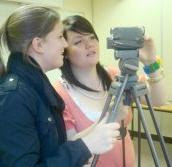
The final scene was recorded straight onto the camera as we wouldn't of had time to edit the footage on the computer. I worked with the group that I will be doing my final coursework with, and together we decided on what would happen in our sequence.


Our sequence was...
- Establishing shot of door
- Close up of door
- Insert/close up of clock (ticks for a few seconds)
- Close up of fingers tapping on table in time with the ticking of the clock
- Medium close up of door, girl bursts through the door
- Pan follows the girl as she runs to the front

- Medium shot of man sitting down (will be to the left of the screen)

- Girl runs into shot from the right and sits down
- Insert/extreme close up of man's shifty eyes
- Medium close up of man saying "You're late"
- Shot reverse shot of the girl making excuses
- Close up of fist slamming the table as the man says "Enough!"
- Medium close up of the man asking "Have you got it?"
- Insert of bag as girl pulls out an envelope

- Low angle as she starts to hand over the envelope
- High angle shot and match on action as the man receives the envelope

- Girl fastens her bag

- Tilt up to the expression on the girls face
- Long shot of door slamming.

I was working in a group of 3 including Hannah, Matt and myself. Before we could start filming, we had to buy a mini DV tape that we would record the footage straight onto. We filmed our sequence in the Media Centre. As a group, I think we worked really well together. When planning the storyboard, we all had the chance to give our input, and most of our ideas were included in the final sequence, which I believe worked effectively, and suited the criteria. I am confident in saying that we managed to record the footage successfully and efficiently. I am glad that we will be in the same group when completing our final coursework, as I felt that we did do well and didnt have any disagreements. Below is our preliminary task...