Codes and Conventions
-Set in suburbia: There is usually the idea of equilbrium being broken one way or another. When the film is in suburbia, it is likely that there will be a friendly community, where everyone thinks that they know each others business. It will also be a lot quieter area, and may give the impression of isolation and being cut off from the city or sources of help.
-Hero/Villain: There will be a seemingly vulnerable character who will be stalked by a tyrannical character. The basic plot of most horror films follows the villains failing attempts at catching/killing the innocent victim. Majority of the time the victim will prevail as a hero/heroine who overcomes the force of the evil character.
-Female teen victims: In a lot of classic horror films, the victims will be naive, vulnerable teenagers, and most likely female. In some way or another, their innocence is compromised or taken away. However, in more recent horror films, it is beoming increasing popular to have a group of teenagers of both gender put in jeopardy. The typical audience of horror films are teenagers, so the characters situations will feel more realistic to them.
-Characters fate changing: At the start of the film, the victim will seem naive and vulnerable. However, as the story progresses, the character will develop and addapt to the situation. Also, at the start, the character will be with his/her friends and they will be safe, however as they separate from the group, their luck will alter and they will find themselves in danger.
-Weapons: Horrors are less likey to be psychological and more likely to be about a physical confrontatiion between the hero and villain. The most common weapons in horrors are knives and guns, sometimes it will be the hero who kills the villain with their own weapon.
-Blood/Gore: Due to the nature of the weapons involved, there will be inevitable blood and gore in a horror film. The confrontations between the hero and the villain will almost always lead to the death of one of them, or both.
-Music: The music used in horrors adds tension to a scene. It will also be used to shock the audience. It is likely that string instruments will be used to create an atmosphere. Music in thrillers builds up, whereas the music in horrors is more about creating the 'shock' factor.
-Darkness: As with thriller films, darkness is used as a device to create suspicion and tension within the audience. Most of the killings/murders, or action in the film for that matter, will take place at night. It not only darkens the settings, but the tone of the film. It restricts what the audience and characters are able to see.
Saturday, 10 January 2009

Thursday, 8 January 2009
THRILLER - Individual Research
One question that always arises is "what is a thriller film?". There are many different definitions, but with each one being so different, we are given the impression that maybe there is no concrete definition for a thriller, but just a conclusion of ones interpretation of the genre. However, if the genre is defined strictly, a genuine thriller is a film that relentlessly strives to provide thrills and keep the audience on the edge of their seats as the plot build towards a climax.
Thriller is a broad genre of literature, film, TV and gaming that includes various subgenres which will often overlap. Thrillers are known to be fast paced with lots of action. There is almost always a hero/heroine who must use their own resources to overcome the better-equipped villain. There will be extensive use of suspense, red herrings and cliff hangers.
Thrillers often take place in settings that the audience will recognise eg- New York. The hero in a thriller will usuall y be male and accustomed to danger eg- police officer, spies or soldiers. However, it is not uncommon for ordinary citizens to get drawn into danger eg- Edward Norton in Fight Club (1999). It is, however, becoming m
 ore popular to portray a strong female heroine in thriller films, an early example of this is Sigourney Weaver as Ripley in Alien (1979).
 y be male and accustomed to danger eg- police officer, spies or soldiers. However, it is not uncommon for ordinary citizens to get drawn into danger eg- Edward Norton in Fight Club (1999). It is, however, becoming m
 ore popular to portray a strong female heroine in thriller films, an early example of this is Sigourney Weaver as Ripley in Alien (1979).
 In a thriller, a hero must thwart the plans of a villain, rather than solve a crime that has already been committed. The crimes that must be prevented will be on a grand scale eg- serial or mass murder, terrorism, assassination etc. There will almost always be a showdown between good and evil at some point in the film. The hero is not only trying to save his own life. but that of others who have also found themselves in the situation.
Thrillers may be defined by the primary mood that they elicit: fearful excitement. The audience need to be thrilled for it to be a successful thriller.
There are various subgenres that can be woven into a thriller . . .
ACTION THRILLER - race against the clock, lots of violence, obvious antagonist, guns, explosions, special effects, eg- James Bond, Bourne
CONSPIRACY THRILLER - hero confronts a large powerful group of enemies whose true extent only he realises, eg- JFK (1991)
CRIME THRILLER - suspenseful account of a crime/s, murder, robbery, shootouts, double crosses, eg- Seven (1995), Reservoir Dogs (1992)
DISASTER THRILLER - artifical or natural disaster, floods, earthquakes, hurricanes, eg- The Day After Tomorrow (2004)
DRAMA THRILLER - slower paced, character development, plot twists, eg- The Interpreter (2005)
ECO THRILLER - environmental/biological disaster
EROTIC THRILLER - eg- Basic Instinct (1992), Fatal Attraction (1987)
LEGAL THRILLER - courtroom, fighting for justice and life eg- The Exorcism of Emily Rose (2005)
MEDICAL THRILLER - hero/heroine is a doctor or nurse, hospital, eg- Awake (2007)
PSYCHOLOGICAL THRILLER - mental/emotional conflict rather than physical, eg- Strangers on a Train (1951)
SPY THRILLER - hero= government agent, terrorists, eg James Bond
SUPERNATURAL THRILLER - one of the main characters has supernatural powers, eg- Carrie (1976)
TECHNO-THRILLER - military technologies, technology is essential to the understanding of the plot
HORROR THRILLER - conflict between good and evil are mental/emotional/physical, eg- 28 Days Later (2002), Saw (2004)
Most thrillers will be a combination of various subgenres. The ones that are most commonly used to heighten the tension are horror, conspiracy and psychological. The tension usually arises when the main character is placed in a predicament that is out of the ordinary. Escaping from the situation will seem almost impossible. Life itself is threatened, usually because the main character is unknowingly or reluctantly involved in the events.
One of the most famous thriller directors is Alfred Hitchcock - The Master of Suspe nse.
nse.
 nse.
nse.He helped to shape the modern day thriller genre, beginning with his early silent film The Lodger (1926). He made cameos in almost all of his films within the first 10 minutes - a trademark of the famous director. Although he was nominated for the Academy Award for Best Director 5 times, he never won it.
Hitchcock is considered as the master of the thriller or suspense genre, and manipulating his audiences fears and desires by showing the viewer the reality facing the character. He would often incorporate a taboo or sexually-related theme into his films like voyeurism in Rear Window (1954), obsession in Vertigo (1958), and the twisted oedipus complex in Psycho (1960).
His films would often put an innocent character in a life-threatenting situation in a case of mistaken identity eg- The Wrong Man (1956).
Hitchcock utilized various cinematic techniques in his films
- Extreme zoom - the key in Notorious (1946)
- Cross cutting 'tennis match' - Strangers on a Train (1951)
- Dolly zoom/Hitchcock shot/Vertigo effect/Contra zoom/zoom in zoom out - Vertigo (1958)
- Montage accentuated with a screeching violin score - Psycho (1960)
The shower scene in Psycho is one of cinemas most stunning and visually effective sequences. A lot of the poignancy is because of the editing. The fast cuts make the scene frantic and realistic.Most of the shots are from the point of view of the knife. This makes the scene much more personal to the audience. Also, it limits the gore in the scene (which is also why it was shot in black and white). In addition, the knife never actually penetrates the skin, and because the scene goes so fast, you think you see more than you actually do - it left a lot to the imagination. I think the scene implies that thrillers are not defined by their subject matter, but by their approach to it. The violin score by Bernard Hermann only adds to the effect and power of the sequence. This would be something to consider if we did a thriller. Psycho proves that it can see really effective without all the gore. Seamless editing is essential, as well as an appropriate sound track.
In majority of his films, there was the inevitable life and death chase concluding with a showdown at a familiar landmark eg- Golden Gate Bridge (Vertigo). He also reveled in confined space to heighten emotion.
The famed director often captialized on a red herring or a plot element to cath the viewers attention. The audience believe that it will be an important feature in the film, but it will intentionally mis-direct the audience, it then quickly fades into the background and ends up being trivial and irrelevant to the films story.
- Rear Window: Suspected murder committed by the apartment tenant
- Psycho: The stolen $40,000 wrapped in newspaper at Bates Motel
- The Birds: The cause of the strange bird attacks.
Hitchcock would typically cast leading actors against type (James Stewart, Cary Grant) opposite blonde actresses (Ingrid Bergman, Grace Kelly, Janet Leigh, Tippi Hendren) who were often subject to abuse, threatening humiliation or murder. Hitchcock would explore the darker sides of human nature through the situation, including sexuality and voyeurism, guilt and punishment, or paranoia and obsession. He would usually let the audience know that something horrible would happen- thus creating suspense while the audience waiting for the inevitable.
In majority of his films, there was the inevitable life and death chase concluding with a showdown at a familiar landmark eg- Golden Gate Bridge (Vertigo). He also reveled in confined space to heighten emotion.
The famed director often captialized on a red herring or a plot element to cath the viewers attention. The audience believe that it will be an important feature in the film, but it will intentionally mis-direct the audience, it then quickly fades into the background and ends up being trivial and irrelevant to the films story.
- Rear Window: Suspected murder committed by the apartment tenant
- Psycho: The stolen $40,000 wrapped in newspaper at Bates Motel
- The Birds: The cause of the strange bird attacks.
Hitchcock would typically cast leading actors against type (James Stewart, Cary Grant) opposite blonde actresses (Ingrid Bergman, Grace Kelly, Janet Leigh, Tippi Hendren) who were often subject to abuse, threatening humiliation or murder. Hitchcock would explore the darker sides of human nature through the situation, including sexuality and voyeurism, guilt and punishment, or paranoia and obsession. He would usually let the audience know that something horrible would happen- thus creating suspense while the audience waiting for the inevitable.
Friday, 2 January 2009
THRILLER - Analysis
Red Dragon :
:
To get more familiar with the thriller genre, we watched some films in lesson. The first film we watched was Red Dragon. It is the 2002 prequel to The Silence of the Lambs directed by Brett Ratner, and starred Anthony Hopkins and Edward Norton.
The film begins in a theatre as an orchestra are playing, it is an extreme long shot as well as an establishing shot, and the setting suggests that the characters in the film are intelligent, upper class people. The camera then slowly zooms into a close up of Hannibal Lector's face, introducing him to the audience. The audience are given the impression that Lector is well educated as he sits and appreciates the music that is being played. The music compliments the slow camera movements. Within the orchestra, there is a flute player who is out of tune. We then see Lector's face once again as he singles out and concentrates on the flut player who is making the mistake. This once again shows his intelligence. The music builds up to a cresendo as the action begins, helping to create tension in the audience and to suggest that something dramatic is going to happen.
The film continues in Hannibal Lector's house at dinner. Hannibal seems very poilte, and when the group are talking about the missing flute player, he remains calm and composed under the pressure. When he is asked to confess, there is a close-up on his worried face- hinting that he knows something. When the person who asked him the question continues with the conversation, Lector seems relieved, showing the audience that he has been up to something, and may have had something to do with the missing flute player.
Lector's house is large, and the furniture inside is very traditional and clearly shows that he is a wealthy man. The ornaments ar-ound the house also show that he is very cultural. Also, it is noticeable that there are a lot of books in the house, continuing the theme of Lector's intelligence. He keeps a tidy house that is full of eccentric artifacts and expensive furniture. This not only gives the impression that he is rich, but also powerful. Also, the carpet in Lector's house is a very dark red symbolizing danger, anger and blood - an ominous sign of what is going to happen.
The lighting in the scene is very dark and reflects the mood and the character that has been introduced. In comparison to the other people in the scene, Hannibal Lector is shown in a darker light, suggesting that he has a darker, more sinister side to him, that hasn't yet been revealed to the audience.
The is extensive use of pans in the sequence to show spacial awareness in the scene. The cuts and editing are slow and steady to gradually entice the audience into the story. Also, it could reflect the way Hannibal Lector works - subtly and silently, progressing unnoticed.
When Will Graham is looking around Lector's possessions, the music builds up as he is discovering new things about the character.The music being played is quite edgey and scratchy, there is also a lot of string instruments being played. The music accompanies the clips in parallel shots. There is a reaction shot when Graham realises that Lector is the killer. After Graham has looked at the cookbook and discovered the truth about Lector, the music gets high pitched as Lector stabs him. The music gets louder and develops into a beat, which could be perceived as Graham's heart beat. After he has stabbed Graham, the audience are shown that Lector has a more caring side, as he "doesn't want Graham to feel any pain". It is obvious to the audience that Lector has experience in this situation as he is well rehearsed in what Graham is going through ie- "you are in shock now".
Another important factor in the opening sequence is the scrapbook. The audience can see it being made piece by piece. It is a way of keeping the audience up to date with Hannibal's story. It is a form of dramatic irony as the audience are aware (or think they are aware) of the criminal before the police in the film do.
The verbal codes in the opening sequence also indicate a sub-genre or theme in the film. As the credits appear, the word 'Red' fades from white to red and the word 'Dragon' stays white. This could have been done to achieve various effects. Firstly, it could show a slow change in a character from good to bad. It could also be symbolic of the conflict between good and evil, and the fact that there is both in everyone.
Seven :
:
Seven (SE7EN) is a 1995 thriller film directed by David Fincher. It stars two of Hollywoods most respected actors Brad Pitt and Morgan Freeman.
The opening of Seven follows the typical thriller formula where the characters are introduced to the audience. We are also given the advantage of seeing into the characters homes and lives. We are initially introduced to Morgan Freeman's character - Detective Somerset. The first shot in which we see Somerset is a low-angled medium shot- instantly giving him an amount of respect and authority. Throughout the opening sequence, most of the shots range from medium to close up. The movement of the camera develops gradually in the sequence to assist in building the tension and suspense in the film. However, it is noticeable that the camera is a lot smoother when Somerset is in the shot as oppose to when Brad Pitt's character - Detective Mills is. There are various ways in which Detective Somerset and Detective Mills are contrasted, not only in the opening sequence, but throughout the rest of the film.
SOMERSET: At the beginning of the film, we see Somerset getting ready in his house. It is a very calm house, indicating that he lives alone. His clothes/uniform are ready on th e bed and look meticulous. They look like clothes for a stereotypical detective. Also, there is a lot of white furniture in the house, although it is still quite dark. This could mean that he is good, innocent man with a potential shadow looming over him. The camera movement in Somersets house is often slow, smooth tracking and panning, to mirror how Somerset acts later in the scene and film, despite the situation he may be in. Another noticeable feature in Somerset's house is a chess board, which is an indicator to the audience that he is an intelligent man. This is also evident because of the amount of the books in the house. When he is walking through the street with Mills later in the scene, he isn't fazed by what is going on around him as he walks calmly with his hands behind his back. Just before the opening credits begin, Somerset lies in bed with a metronome on his bedside table. This could be suggesting different things. Firstly, it could show how he has a methodical approach to his work and his life. Also, it could be a reflection on the fact that he has trouble sleeping- maybe because if his job. The rhythm of the metronome is similar to that of a heartbeat.
MILLS: Detective Mills is representative of a younger generation. The most obvious difference between the tw o characters is the age. As he wakes up in the morning, it is noticeable that his and his wife's flat is quite dark and gloomy. Mills is in a rush and is unorganised. His tie is hanging up in the same knot from the last time he wore it. He takes less care in his appearance than Somerset. When he is walking with Somerset, he looks uneasy in his surroundings and has to move out of the way for everyone else, as if no-one notices him. He is wearing a leather jacket which appears unprofessional and quite rebellious. They also have different approaches to how they work, Somerset is analytical of the crime scene, whereas Mills doesn't really stop to assess the situation. The camera is a rougher to reflect how he has flaws. Althoug
 h they are made to look different a lot of the time, there is also the use of low-angled shots looking up are both of them, giving them equal authority.
The location of the film also plays a big part in the story, even though it is purposely not revealed. It is a fictional city of constant rain and urban decay that mirrors the general tone of the film. However, it is believed to be New York, because of the surroundings and features. It is a typical inner city are and through the use of mise-en-scene, it is clear to the audience that the area is not a particularly nice place and quite dangerous. This is because of the walls covered in graffiti. Also, when they get to the crime scene, there is a lot of blood up the window in the background.
Throughout the opening sequence, the weather and lighting are significant in setting the tone. The weather - constant raining - reflects pathetic fallacy, making everything dark and gloomy. The rain is a religious symbol of the sins being washed away one by one. The darkness acts as a cover for the criminal who is committing the horrific crimes. The mysterious surroundings put both of the main characters out of their comfort zones, showing that they do share some things in common. All of the characters are in the dark as they dont know what is going to happen to them. To create tension in the opening sequence, and for most of the film, the audience do not see the killers face.
Music is used for a dramatic effect during the opening credits. The ticking of Somerset's metronome develops into a heartbeat, which integrates with the scratchy music. The screen is black and the actors names appears. They match the distortion of the music. The font is as if it was written by a child. The credits are white on a black background. It is suggesting that the theme of the film is good characters getting drawn into dark, sinister secrets.
There is also the use of a scrapbook in the credits, an indication that the crime has been planned which makes it even more sadistic. The editing in this section is very messy and unorganised, which could reflect someones life or attitude to life.
 :
:To get more familiar with the thriller genre, we watched some films in lesson. The first film we watched was Red Dragon. It is the 2002 prequel to The Silence of the Lambs directed by Brett Ratner, and starred Anthony Hopkins and Edward Norton.
The film begins in a theatre as an orchestra are playing, it is an extreme long shot as well as an establishing shot, and the setting suggests that the characters in the film are intelligent, upper class people. The camera then slowly zooms into a close up of Hannibal Lector's face, introducing him to the audience. The audience are given the impression that Lector is well educated as he sits and appreciates the music that is being played. The music compliments the slow camera movements. Within the orchestra, there is a flute player who is out of tune. We then see Lector's face once again as he singles out and concentrates on the flut player who is making the mistake. This once again shows his intelligence. The music builds up to a cresendo as the action begins, helping to create tension in the audience and to suggest that something dramatic is going to happen.
The film continues in Hannibal Lector's house at dinner. Hannibal seems very poilte, and when the group are talking about the missing flute player, he remains calm and composed under the pressure. When he is asked to confess, there is a close-up on his worried face- hinting that he knows something. When the person who asked him the question continues with the conversation, Lector seems relieved, showing the audience that he has been up to something, and may have had something to do with the missing flute player.
Lector's house is large, and the furniture inside is very traditional and clearly shows that he is a wealthy man. The ornaments ar-ound the house also show that he is very cultural. Also, it is noticeable that there are a lot of books in the house, continuing the theme of Lector's intelligence. He keeps a tidy house that is full of eccentric artifacts and expensive furniture. This not only gives the impression that he is rich, but also powerful. Also, the carpet in Lector's house is a very dark red symbolizing danger, anger and blood - an ominous sign of what is going to happen.
The lighting in the scene is very dark and reflects the mood and the character that has been introduced. In comparison to the other people in the scene, Hannibal Lector is shown in a darker light, suggesting that he has a darker, more sinister side to him, that hasn't yet been revealed to the audience.
The is extensive use of pans in the sequence to show spacial awareness in the scene. The cuts and editing are slow and steady to gradually entice the audience into the story. Also, it could reflect the way Hannibal Lector works - subtly and silently, progressing unnoticed.
When Will Graham is looking around Lector's possessions, the music builds up as he is discovering new things about the character.The music being played is quite edgey and scratchy, there is also a lot of string instruments being played. The music accompanies the clips in parallel shots. There is a reaction shot when Graham realises that Lector is the killer. After Graham has looked at the cookbook and discovered the truth about Lector, the music gets high pitched as Lector stabs him. The music gets louder and develops into a beat, which could be perceived as Graham's heart beat. After he has stabbed Graham, the audience are shown that Lector has a more caring side, as he "doesn't want Graham to feel any pain". It is obvious to the audience that Lector has experience in this situation as he is well rehearsed in what Graham is going through ie- "you are in shock now".
Another important factor in the opening sequence is the scrapbook. The audience can see it being made piece by piece. It is a way of keeping the audience up to date with Hannibal's story. It is a form of dramatic irony as the audience are aware (or think they are aware) of the criminal before the police in the film do.
The verbal codes in the opening sequence also indicate a sub-genre or theme in the film. As the credits appear, the word 'Red' fades from white to red and the word 'Dragon' stays white. This could have been done to achieve various effects. Firstly, it could show a slow change in a character from good to bad. It could also be symbolic of the conflict between good and evil, and the fact that there is both in everyone.
Seven
 :
:Seven (SE7EN) is a 1995 thriller film directed by David Fincher. It stars two of Hollywoods most respected actors Brad Pitt and Morgan Freeman.
The opening of Seven follows the typical thriller formula where the characters are introduced to the audience. We are also given the advantage of seeing into the characters homes and lives. We are initially introduced to Morgan Freeman's character - Detective Somerset. The first shot in which we see Somerset is a low-angled medium shot- instantly giving him an amount of respect and authority. Throughout the opening sequence, most of the shots range from medium to close up. The movement of the camera develops gradually in the sequence to assist in building the tension and suspense in the film. However, it is noticeable that the camera is a lot smoother when Somerset is in the shot as oppose to when Brad Pitt's character - Detective Mills is. There are various ways in which Detective Somerset and Detective Mills are contrasted, not only in the opening sequence, but throughout the rest of the film.
SOMERSET: At the beginning of the film, we see Somerset getting ready in his house. It is a very calm house, indicating that he lives alone. His clothes/uniform are ready on th
 e bed and look meticulous. They look like clothes for a stereotypical detective. Also, there is a lot of white furniture in the house, although it is still quite dark. This could mean that he is good, innocent man with a potential shadow looming over him. The camera movement in Somersets house is often slow, smooth tracking and panning, to mirror how Somerset acts later in the scene and film, despite the situation he may be in. Another noticeable feature in Somerset's house is a chess board, which is an indicator to the audience that he is an intelligent man. This is also evident because of the amount of the books in the house. When he is walking through the street with Mills later in the scene, he isn't fazed by what is going on around him as he walks calmly with his hands behind his back. Just before the opening credits begin, Somerset lies in bed with a metronome on his bedside table. This could be suggesting different things. Firstly, it could show how he has a methodical approach to his work and his life. Also, it could be a reflection on the fact that he has trouble sleeping- maybe because if his job. The rhythm of the metronome is similar to that of a heartbeat.
MILLS: Detective Mills is representative of a younger generation. The most obvious difference between the tw
 o characters is the age. As he wakes up in the morning, it is noticeable that his and his wife's flat is quite dark and gloomy. Mills is in a rush and is unorganised. His tie is hanging up in the same knot from the last time he wore it. He takes less care in his appearance than Somerset. When he is walking with Somerset, he looks uneasy in his surroundings and has to move out of the way for everyone else, as if no-one notices him. He is wearing a leather jacket which appears unprofessional and quite rebellious. They also have different approaches to how they work, Somerset is analytical of the crime scene, whereas Mills doesn't really stop to assess the situation. The camera is a rougher to reflect how he has flaws. Althoug
 h they are made to look different a lot of the time, there is also the use of low-angled shots looking up are both of them, giving them equal authority.
The location of the film also plays a big part in the story, even though it is purposely not revealed. It is a fictional city of constant rain and urban decay that mirrors the general tone of the film. However, it is believed to be New York, because of the surroundings and features. It is a typical inner city are and through the use of mise-en-scene, it is clear to the audience that the area is not a particularly nice place and quite dangerous. This is because of the walls covered in graffiti. Also, when they get to the crime scene, there is a lot of blood up the window in the background.
Throughout the opening sequence, the weather and lighting are significant in setting the tone. The weather - constant raining - reflects pathetic fallacy, making everything dark and gloomy. The rain is a religious symbol of the sins being washed away one by one. The darkness acts as a cover for the criminal who is committing the horrific crimes. The mysterious surroundings put both of the main characters out of their comfort zones, showing that they do share some things in common. All of the characters are in the dark as they dont know what is going to happen to them. To create tension in the opening sequence, and for most of the film, the audience do not see the killers face.
Music is used for a dramatic effect during the opening credits. The ticking of Somerset's metronome develops into a heartbeat, which integrates with the scratchy music. The screen is black and the actors names appears. They match the distortion of the music. The font is as if it was written by a child. The credits are white on a black background. It is suggesting that the theme of the film is good characters getting drawn into dark, sinister secrets.
There is also the use of a scrapbook in the credits, an indication that the crime has been planned which makes it even more sadistic. The editing in this section is very messy and unorganised, which could reflect someones life or attitude to life.
Sunday, 30 November 2008
THRILLER - Codes & Conventions
Codes and Conventions
-Darkness: This makes the audience feel that something is being hidden from them. It sometimes makes a scene more realistic/believeable and therefore more intense. Darkness in a scene provides a cover for any crimes that are being committed. The use of lighting in thriller films creates the shadows which will leave the audience making guessing about what is going to happen next.
-Creepy: Suspense is created throughout the film. There are various ways in which this is achieved (darkness being the most obvious way). As tension builds up, the pace of the film gathers leading up to the conclusion. The audience is manipulated by the director to feel certain ways at different points in a film. The intention of a thriller is to build up tension for the audience for the conclusion, whilst still scaring them at the same time. This is sometimes achieved by the use of quick cuts.
-Close Ups: Not being able to see a lot of what is going on behind the characters makes the audience feel more connected to them and their story, as they are not distracted by what is going on in the background. Also, it could imply that there aren't any weapons involved and that there are more psychological elements to the film. It also gives the audience the chance to see the characters emothions and subtle reactions to the events in the film.
-Objective Point of View: Another common shot in thriller films is the objective point of view. This is when the audience can see what the character cant. Essentially, we are in a much better position than the character. The audience will feel a connection to the character as they empathise with them and want them to survive over the villain or source of evil.
-Theme: A common theme in thriller films is a crime being committed and/or investigated. In most cases, the crime/s are down to a serial killer. Thriller films typically follow the efforts of a detective trying to piece together the evidence of a crime that has been committed. However, whilst this is going on, the serial killer will be planning his/her next crime.
-Sound: The use of sound is critical in thriller films, as it creates an atmosphere and tone to the film. The use of string instruments e.g. violins, assists in creating a tense atmosphere. As the pace of the film gathers the frequency of the music does as well. It builds up throughout the film as the plot develops. When there is a crucial event in the film, the strings will build up to indicate to the audience that something is happening. The event will be marked by the cresendo of the music. Sometimes to create even more tension, the music will be built up and there will be a sort of anti-climax, so that the audience are expecting something to happen.
-Red Herring/Twist: Thrillers are well known for evoking thought within the audience. When watching thrillers, people will be considering what the character is - or should be - doing, and how they, themselves, would react in the situations portrayed in the film. Thrillers are a lot less predictable than other genres like romantic comedies, and people watching them are constantly left guessing. An important factor in making the film unpredictable and effective at the same time is a red herring/twist. The audience are lead to believe certain things as the film progresses, but as the story unfolds, certain things are revealed about a character or the story that completely changes the audiences perception.
Friday, 28 November 2008
Preliminary Task
For our preliminary task, we had to create a short sequence which included the following:
- Someone walking through a door and sitting on a chair
- A brief conversation between 2 charcters
- The exchanging of an object (of our choice) from one character the other
When filming the sequence, we had to keep in mind the following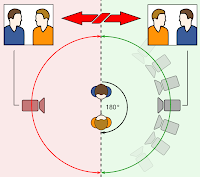
- Obide by the 180 degree rule
- Include a shot reverse shot
- Include a match on action
The final scene was recorded straight onto the camera as we wouldn't of had time to edit the footage on the computer. I worked with the group that I will be doing my final coursework with, and together we decided on what would happen in our sequence.
Our sequence was...
- Establishing shot of door
- Close up of door
- Insert/close up of clock (ticks for a few seconds)
- Close up of fingers tapping on table in time with the ticking of the clock
- Medium close up of door, girl bursts through the door
- Pan follows the girl as she runs to the front
- Medium shot of man sitting down (will be to the left of the screen)
- Girl runs into shot from the right and sits down
- Insert/extreme close up of man's shifty eyes
- Medium close up of man saying "You're late"
- Shot reverse shot of the girl making excuses
- Close up of fist slamming the table as the man says "Enough!"
- Medium close up of the man asking "Have you got it?"
- Insert of bag as girl pulls out an envelope
- Low angle as she starts to hand over the envelope
- High angle shot and match on action as the man receives the envelope
- Girl fastens her bag
- Tilt up to the expression on the girls face
- Long shot of door slamming.
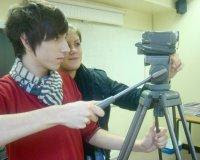
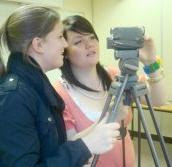 I was working in a group of 3 including Hannah, Matt and myself. Before we could start filming, we had to buy a mini DV tape that we would record the footage straight onto. We filmed our sequence in the Media Centre. As a group, I think we worked really well together. When planning the storyboard, we all had the chance to give our input, and most of our ideas were included in the final sequence, which I believe worked effectively, and suited the criteria. I am confident in saying that we managed to record the footage successfully and efficiently. I am glad that we will be in the same group when completing our final coursework, as I felt that we did do well and didnt have any disagreements. Below is our preliminary task...
- Someone walking through a door and sitting on a chair
- A brief conversation between 2 charcters
- The exchanging of an object (of our choice) from one character the other
When filming the sequence, we had to keep in mind the following

- Obide by the 180 degree rule
- Include a shot reverse shot
- Include a match on action
The final scene was recorded straight onto the camera as we wouldn't of had time to edit the footage on the computer. I worked with the group that I will be doing my final coursework with, and together we decided on what would happen in our sequence.
Our sequence was...
- Establishing shot of door
- Close up of door
- Insert/close up of clock (ticks for a few seconds)
- Close up of fingers tapping on table in time with the ticking of the clock
- Medium close up of door, girl bursts through the door
- Pan follows the girl as she runs to the front
- Medium shot of man sitting down (will be to the left of the screen)
- Girl runs into shot from the right and sits down
- Insert/extreme close up of man's shifty eyes
- Medium close up of man saying "You're late"
- Shot reverse shot of the girl making excuses
- Close up of fist slamming the table as the man says "Enough!"
- Medium close up of the man asking "Have you got it?"
- Insert of bag as girl pulls out an envelope
- Low angle as she starts to hand over the envelope
- High angle shot and match on action as the man receives the envelope
- Girl fastens her bag
- Tilt up to the expression on the girls face
- Long shot of door slamming.
 I was working in a group of 3 including Hannah, Matt and myself. Before we could start filming, we had to buy a mini DV tape that we would record the footage straight onto. We filmed our sequence in the Media Centre. As a group, I think we worked really well together. When planning the storyboard, we all had the chance to give our input, and most of our ideas were included in the final sequence, which I believe worked effectively, and suited the criteria. I am confident in saying that we managed to record the footage successfully and efficiently. I am glad that we will be in the same group when completing our final coursework, as I felt that we did do well and didnt have any disagreements. Below is our preliminary task...
Thursday, 27 November 2008
Purpose of an Opening
The main intention of a films opening is to grab the audiences attention and hook them into watching the rest of the film. This is done by questions being left unanswered. The opening of a film will introduce the main characters to the audience, and will set the mood/tone of the film at the same time. It is a chance for the setting/location of the story to be displayed. It will also give a brief insight as to what the storyline of the film will include. All of these things make the audience want to continue watching, and this is mainly because of the editing. The editing of the sequence is the directors manipulation of the audience to get them absorbed into the film.
Monday, 17 November 2008
Codes and Conventions
To get a better understanding of each genre, we watched 3 film (focusing on the opening). Each of the films portray the codes and conventions that are typical for Thrillers, Horrors and Romantic Comedies.
 Released in 2002, Red Dragon is the prequel to The Silence of the Lambs, directed by Brett Ratner, and starring Anthony Hopkins and Edward Norton.

Four Weddings and a Funeral is a 1994 romantic comedy starring Hugh Grant and Andie MacDowell. It was directed by Mike Newell.
Thriller - Red Dragon
Released in 2002, Red Dragon is the prequel to The Silence of the Lambs, directed by Brett Ratner, and starring Anthony Hopkins and Edward Norton.There are a lot of close-ups throughout the film which clearly display characters emotions and subtle reactions. It could be suggested that the close-ups of characters faces in Red Dragon are a way of showing that there isn't necessarily a weapon used, the plot may be more psychological. There is an extensive use of objective point of view shots in the film, which give the audience the advantage of being able to see what the characters cant. This is a way of making the audience "connect" to the vulnerable character, as they feel sorry for him and want to help him. Majority of the film is very dark, which puts the audience on edge and also starts to build the tension. The darkness is also used as a cover for the crimes that are taking place. Another way in which tension is built is through the use of music. It consists mainly of string instruments which create an eerie atmosphere. As the tension in the film gathers, the pace starts to increase as well. Another common feature in the film, as with many thrillers, is the red herring - the audience are convinced of the ending and as the climax of the film approaches, there is a twist or break in the block and there will be a revelation of some sort that changes our perception of a particular character or the film as a whole.


Halloween is a 1978 film, directed by John Carpenter, starring Donald Pleasence and Jamie Lee Curtis.
A common theme in horror films is the concept of a broken equilibrium or formula. They will usually involve the innocence of the main character/victim being compromised. The victims in horror films are usually teenage girls, as the audience see them as vulnerable and naive, this is reflected in the choice of casting Jamie Lee Curtis for the role of Laurie Strode in the film. This also gives dramatic effect to the events of the film. As the equilibrium is broken, tension starts to build up and a more sinister mood/tone develops. Mystery also plays a big part in horror films, as the audience know that something is happening, but we dont know who is doing it. The mystery (and therefore tension) is created by the masking of the killers face. There are also shots and lighting used so that the killers identity remains concealed e.g. dark, over the shoulder/subjective point of view. A lot of the outcomes in the film seem to be left up to fate/chance as the events appear to be unanticipated and unpredictable. In most horror films, there will be a hero/victim and a villain. It is inevitable that there will be deaths in the film, and there is usually a battle towards the end of the film between good and evil, which is most likely to contain lots of blood and gore. The main purpose of a horror film is to scar the audience or make them jump. An effective way of achieving this is through the use of sound/music, as this, coupled with the editing, creates tension and fear among the audience and puts them on edge. There will usually be high pitched string instruments which gather pace and frequency as the scene becomes increasingly intense. At the end of the film, there will be a survivor, who is believed to of overcome the villain. However, there is almost always a cliffhanger at the end of a film, Halloween being a perfect example, suggesting that the villain isn't dead.
Romantic Comedy - Four Weddings and a Funeral

Four Weddings and a Funeral is a 1994 romantic comedy starring Hugh Grant and Andie MacDowell. It was directed by Mike Newell.
Most romantic comedies will usually follow a very basic formula - a couple who get together, but for some reason face obstacles in their relationship. In the end, the resolution may not always be a happy one, but can show the reality of the relationship between the characters. The characters in romantic comedies are typically middle/upper class, this is so that the audience can identify with them and connect to them and their story. With regard to the storyline/plot, there may be a "cinderella" story between the characters and their status. Another typical feature of a Romantic Comedy is a friend of one or both of the couple, they will help the characters to make decisions and will also be a source of comedy in the film. Most of the situations in the film will be lit brightly to lighten the atmosphere. Finally, the music that is used will be upbeat popular songs that people can easily recognise. The song will almost certainly have words that relate to the narrative of the film e.g. Love Is All Around - Four Weddings and a Funeral.
Subscribe to:
Posts (Atom)